Set and Forget Trading: Plan the Trade, Then Walk Away

Set and forget trading is a method where you decide your entry, stop loss and profit target before you enter, place those orders, and then leave the trade alone until price hits the target or the stop. The work happens up front. After that, your only job is to not interfere. Below you will find how the method works step by step, how to size the trade, which risks remain, and where a signal indicator can fit into the plan.
TL;DR
- Set and forget means every trade has a fixed entry, stop loss and take profit before you click buy or sell, and you do not adjust them because of short-term price noise.
- Risk a small, fixed slice of your account per trade (the common rule is 1% to 2%) and size the position from your stop distance.
- Bracket (OCO) orders let the platform manage the exit, so you can step away without watching the chart.
- Gaps, slippage and leverage can still hurt a set and forget trade, so a stop is a plan, not a guarantee.
- A signal indicator such as Big Move Algo can supply the entry idea. The stop, target and size still come from your own rules.
Table of Contents
- What set and forget trading actually means
- From planning to closing: the process
- Setting entry, stop, target and position size
- Let the platform do the waiting: bracket orders
- Where signals and buy/sell arrows fit
- Our perspective
- How Big Move Algo supports a set and forget routine
- Risks that still apply after you walk away
- Making it stick: a short checklist
- FAQ
- Sources
What set and forget trading actually means
The definition is consistent across the trading education sites that cover it. FXIFY describes it as doing all the analysis beforehand and placing orders with predefined entry, stop-loss and take-profit levels, after which the trade runs on its own and closes when either exit is hit. 2nd Skies Trading adds that it works on any time frame, from weekly charts to intraday.
That last point matters. Many people assume set and forget belongs to swing or position traders only. In practice, a day trader can also fix a stop and target and walk away from a five-minute trade. What changes is how long you are away. Top One Trader notes that the approach resembles swing and position trading, where you might place one or two well-researched setups on the 4-hour or daily chart and check back only when the trade needs a real review. If you want a primer on that style, our guide to swing trading for beginners covers it.
Who it suits
The method fits traders who have a job, a family or simply a limited attention span for screens. Forex School Online points to people who cannot watch charts all day or who prefer longer time frames and hold trades overnight.
It also fits traders who know their own habits. If you tend to move a stop the moment a trade goes red, or close a winner early because it feels uncomfortable, handing the exit to pre-set orders removes those decisions.
What it does not mean
It does not mean ignoring the market. Top One Trader points out that traders still track news events, account risk and whether the original setup remains valid. What they resist is moving stops or targets just because price wiggled. Forget the noise, not the plan.
From planning to closing: the process
The process is the same for every trade. Consistency is the entire point. Here is the sequence, drawn from the workflow that Forex School Online lays out and extended with the steps most traders add.
- Set your account-level rules first. Before you look for a trade, know how much of your account you will risk on one position, and write down how you manage and exit trades. Our trading plan template gives you a fill-in version with a worked example.
- Find the setup. This is your trigger: a level, a pattern, a candle close, or a signal from an indicator.
- Work out the whole trade at once. Decide the entry, where the stop goes and where you take profit before you enter.
- Calculate position size from the stop distance and your risk budget.
- Enter and immediately place the stop and target. Do not promise yourself you will add them in a minute.
- Leave it. Price will either reach the target or take you out at the stop.
- Log the result and review it with the rest of your trades, not in the middle of the trade.
Why leaving it alone helps
Nial Fuller of Learn To Trade The Market argues that traders who tweak a trade after entry tend to start an emotional roller coaster that leads to over-trading. His view is that if your edge is present, you execute it and stay out unless you have a valid price action reason. That is one trader’s argument, but it matches what many people find: fewer in-trade decisions means fewer emotional ones.
One rule from EdgeFlo is worth taping to your monitor: do not set and forget on Monday, trail on Tuesday and take partials on Wednesday. Pick one management style for a given strategy and apply it every time, otherwise you cannot tell which approach is producing your results.
Setting entry, stop, target and position size
This is where the trade is really won or lost, because once you walk away, these four numbers are all you have.
Entry
The entry is usually a limit order at a level you chose in advance, or a condition such as a candle close above a breakout level. CatchTheBull describes entries as limit orders at support or candle-close conditions set ahead of time.
Stop loss
Put the stop where the trade idea is proven wrong, not where the loss feels tolerable. For a buy at support, that is below the support. For a breakout buy, it is below the breakout level. FXIFY cautions that stops and targets should rest on market structure, recent volatility or key price zones, because poorly placed exits can close trades prematurely or cause large drawdowns.
Profit target
A common choice is the next significant resistance level for a long. Then check the reward against the risk. CatchTheBull suggests a risk-to-reward ratio of at least 2:1, ideally 3:1 or better. Investopedia’s five-step trade test runs through the setup, trigger, stop, price target and risk-reward assessment, and says to take only trades with a favorable ratio.
Position size
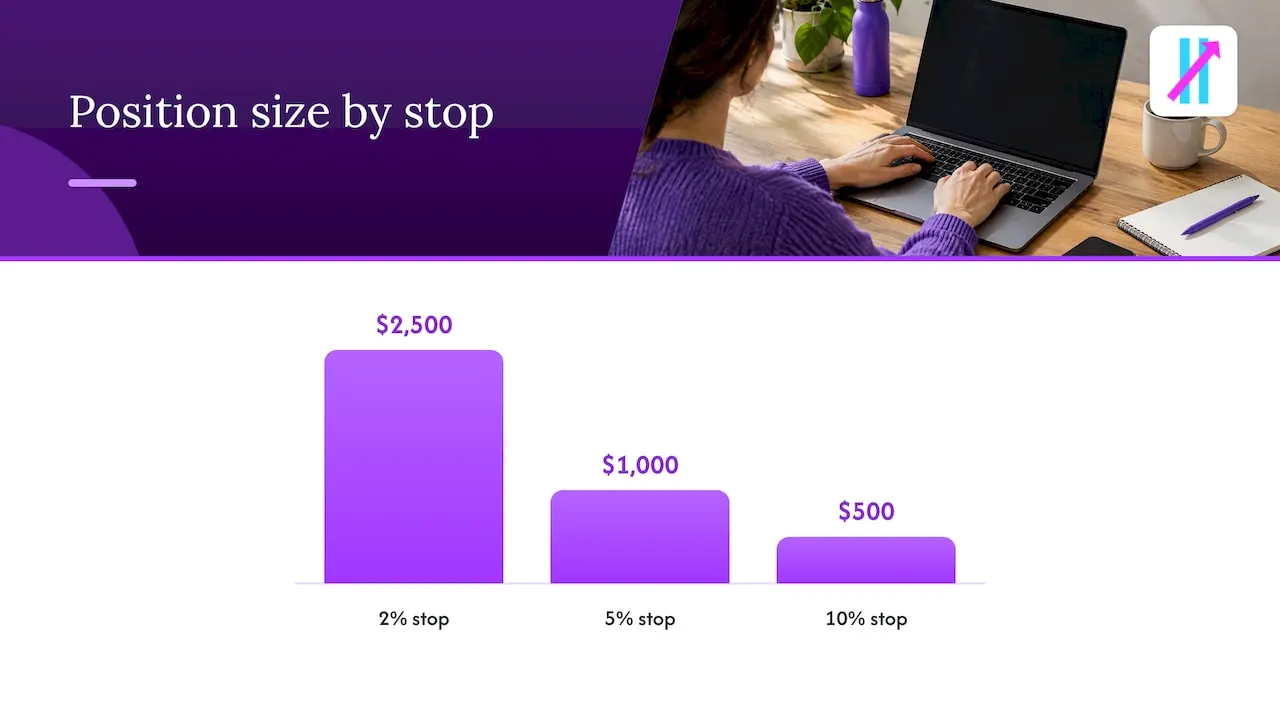
The usual formula is: position size = (account × risk %) ÷ stop distance in %. CatchTheBull gives this example: on a $5,000 account risking 1%, your maximum loss is $50. With a stop 5% below entry, the position is $50 ÷ 0.05 = $1,000. The same source states the rule of never risking more than 1% to 2% of the account on a single trade.
Here is that logic in a table, using the same 1% risk on a $5,000 account:
| Stop distance | Max loss | Position size |
|---|---|---|
| 2% | $50 | $2,500 |
| 5% | $50 | $1,000 |
| 10% | $50 | $500 |
Notice what happens: a wider stop means a smaller position, so the dollar risk stays the same. For a volatility-based approach to stop distance, see our walkthrough of position sizing with a 1% fixed fraction and ATR. If you want to go deeper on setting a consistent loss budget, these trade management strategies cover the 2% rule for self-directed traders.
Let the platform do the waiting: bracket orders
A bracket order places the entry, the take profit and the stop loss together. TradingwithRayner explains that when the profit order fills, the stop is canceled, and when the stop fills, the profit order is canceled. That is what makes it practical to walk away.
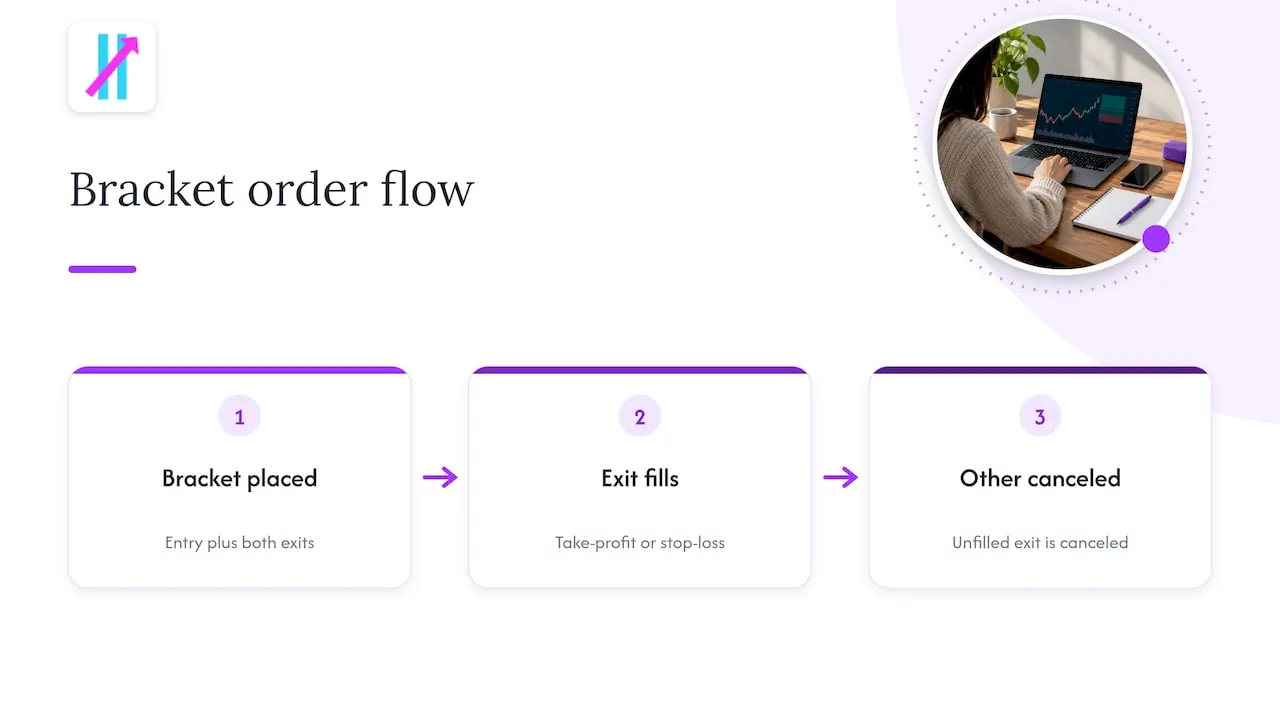
The idea is not new. In a 2014 Options Insider piece, trader Sam Seiden describes using an OCO (order cancels order) setup, with a buy order at demand, a protective stop and a limit order for profits placed together, so he stays hands-off from start to finish.
Before you rely on this, confirm what your broker supports: whether bracket or OCO orders are available for your instrument, whether the order stays active overnight, and how partial fills are handled. Those settings differ from broker to broker, and a mismatch is the most common way a “set and forget” trade ends up unprotected.
Where signals and buy/sell arrows fit
Most readers searching for set and forget signals or a buy/sell arrow indicator want the same thing: a clear prompt for when to enter, so they are not staring at charts. A signal can do that job well. It answers the “when” and “which direction” of step 2 in the process above.
What a signal does not do is replace steps 3 to 5. One analysis of using signals without overleveraging frames a signal as a condition set that suggests a better trade than a random entry, with no power until it is turned into a risk-defined trade with a stop distance and an expected payoff. We agree with that framing, and it is how we designed Big Move Algo to be used. For more on this, read our piece on the role of entry signals in trade planning.
What to look for in an arrow indicator
Whatever indicator you use, these are sensible questions to ask of any arrow-style tool:
- Does it repaint? An arrow that appears on a closed bar and stays there gives you something to plan around. An arrow that moves or vanishes after the fact does not. Big Move Algo is built to not repaint.
- Does it tell you when to get out? Entries alone leave you improvising the exit. Look for an exit signal as well as long and short.
- Does it say when not to trade? Choppy, directionless conditions produce poor signals in every system. Our Fake Trend Detector is designed to filter out low-quality conditions where trading may not be recommended.
- Are the historical results read properly? Backtests can mislead if built carelessly. Our backtest pitfalls checklist and the guide to the TradingView Strategy Tester show how to read them.
Our perspective
Most traders do not fail for lack of indicators. They fail in the minutes after the entry, when a trade moves against them and the plan gets rewritten on the fly.
That is why we built Big Move Algo around clarity. A Long, Short or Exit signal gives you a defined moment to act, so you spend your attention on the part that matters: sizing the trade and setting the stop and target before you enter. AUTO Mode lets you start quickly with minimal setup, and Manual Mode gives experienced traders room to adjust.
Set and forget works when the rules are made calmly and followed mechanically. Structured signals, a Fake Trend Detector that screens out low-quality conditions, and alerts that reach multiple platforms are designed to support exactly that discipline. Pair them with a written plan and a fixed risk per trade, and you have a process rather than a hunch.
Steven Hartwell
How Big Move Algo supports a set and forget routine
Big Move Algo is a TradingView indicator that gives Long, Short and Exit signals across crypto, forex, stocks, indices and commodities. Alerts can go to multiple platforms, it works on unlimited devices, and it can connect to automated trading platforms. Our guide to using automation shows how traders route alerts into their workflow.
Plans are billed monthly or yearly, and access is instant after payment through Stripe:
| Plan | Monthly | Yearly |
|---|---|---|
| Version 2 | $55 per month | $660 per year |
| Version 3 | $64 per month | $768 per year |
| Version 3 Plus | $79 per month | $948 per year |
You can compare the versions and subscribe on the Big Move Algo site. If you automate, read our notes on risk controls every TradingView user needs first, so your size and stop rules travel with the signal.
Risks that still apply after you walk away
A preset stop feels like a wall. It is closer to a plan, and traders should understand what can go around it.
- Leverage. One risk disclosure notes that leverage magnifies profits and losses, so a small adverse move can produce a large loss relative to your margin and equity.
- Gaps. The same disclosure explains that overnight and weekend gaps can cause stop orders to fill at materially worse prices than requested.
- Slippage. It can be more frequent during volatility, low liquidity or news releases, and stop-loss and take-profit orders are not guarantees.
- Volatile, news-driven markets. MFC notes that gaps and slippage can trigger stops unexpectedly, which matters most when a fixed daily loss limit is in play, as with prop accounts.
The practical response is to size for the gap, not just the stop. If your risk is 1% and a gap could double the loss, you want to know that before the trade, not after. Check the economic calendar for the instrument, and think twice about holding a leveraged position through a scheduled high-impact release or over a weekend. If you trade with margin, talk to your broker about how stop orders are handled in your account.
The cost of a fixed target
EdgeFlo points out that a fixed exit can cap an extended move: you aim for 3:1 and price runs to 6:1. That is the price of simplicity. Some traders accept it. Others split the position, or choose a target based on a level further out. Whichever you pick, choose it before entry and apply it every time.
Signs it is time to pause
MFC lists three warning signs worth tracking: the market structure has changed, execution quality has worsened, or you keep making exceptions to your own rules. The third is the easiest to catch. Keep a simple journal, and if you see more than a few overrides in a month, stop trading the plan live and review it.
Making it stick: a short checklist
- Write the plan before the trade, not during it.
- Fix your risk percentage and keep it fixed.
- Place stop and target the moment you enter, ideally as a bracket order.
- Do not move a stop farther away. Moving it only to reduce risk is a deliberate choice you should define in the plan, not an impulse.
- Review results after 20 or more trades rather than after each one.
- Use confirmation rules consistently. Our article on confirmation versus anticipation explains how to pick one and stay with it.
- Build the whole thing into a repeatable system. These examples of systematic trading frameworks show what that looks like, and our primer on what algorithmic trading is explains how rule-based execution works.
FAQ
What is the set and forget method?
It is a way of trading where you fix the entry, stop loss and profit target before you enter, then leave the trade alone until one of the exits is hit. The analysis and risk decisions happen beforehand. After entry you do not tweak the trade because price moved a little.
Is set and forget trading really hands-off?
Mostly, but not completely. You still track major news, your account risk and whether the original setup is still valid. What you avoid is micromanaging: moving stops or targets in response to short-term swings.
Can a buy/sell signal indicator run a set and forget strategy?
A signal can provide the entry and, with an Exit signal, a rule-based way out. You still need a stop, a target or exit rule, and a position size set from your risk budget. Treat the signal as the trigger, not as the whole plan.
How much should I risk per trade?
A widely used guideline is no more than 1% to 2% of your total account on one trade, with position size calculated from your stop distance. Your own situation may call for less, particularly if you use leverage. A licensed financial professional can help you set a limit that fits your finances.
Sources
- Why ‘Set and Forget’ Trading Works (And When It Doesn’t), FXIFY
- Set and Forget Trading Strategies, 2nd Skies Trading
- Set and Forget Trading Strategy Explained, Top One Trader
- How to Use Set and Forget Trading Strategies, Forex School Online
- Set and Forget Forex Trading, Learn To Trade The Market
- Set and Forget vs Active Trade Management, EdgeFlo
- How to Set Up a Trade for Success, CatchTheBull
- Trade Smart: The 5-Step Approval Process, Investopedia
- The Complete Guide To Bracket Orders, TradingwithRayner
- Plan It, Set It, and Forget It, The Options Insider
- Use Trading Signals Without Getting Overleveraged
- Risk Disclosure Statement, Vittaverse
- Set and Forget Trading: A Guide for Prop Firm Success, MFC