When Not to Trade: 9 Signs to Sit Out a Setup or the Day

You should not trade when the setup does not match your plan, when the risk is unclear, when market conditions are erratic, or when your own state of mind is driving the decision. Skipping a trade is a decision, and often the best one you make all week. The trick is to settle the rules before the session, so you are not negotiating with yourself while money is on the line. That is the idea behind Big Move Algo, a TradingView indicator that gives Long, Short and Exit signals and a built-in Fake Trend Detector that flags low-quality market conditions.
TL;DR
- Skip a trade when you cannot state the idea, the invalidation point and the risk-reward in a sentence or two.
- Skip choppy, thin or news-driven markets where fills and quotes can differ sharply from what you see.
- Stop for the day when you hit a pre-set loss limit, or when you catch yourself chasing, revenge trading or moving stops.
- Write the rules down before the session. Rules made in the heat of a trade rarely hold.
- A filter that flags weak conditions, like our Fake Trend Detector, makes the skip decision easier to follow.
Table of Contents
- Skip the trade: when the setup is the problem
- Skip the market: when conditions undermine any setup
- Stop for the day: emotional and behavioral signs
- Set limits before the session starts
- If you use automation, add risk controls
- Money you should never put at risk
- How Big Move Algo supports the decision to wait
- Our perspective
- FAQ
- Sources
Skip the trade: when the setup is the problem
Most bad trades are bad before you click. Investopedia’s guidance on passing on a trade says to pass when the setup does not match your strategy, when the risk-reward is unclear or unfavorable, or when you are chasing a move after missing the entry.
Use three quick questions:
- Can I state the idea in one sentence? If you cannot say what you expect and what would prove you wrong, you do not have a trade. Caibull Academy makes the same point: wait if the idea has no clear invalidation condition or any item on your checklist fails.
- Does the reward justify the risk? Many disciplined traders set a minimum risk-reward threshold, often 2:1 or higher, and refuse setups that fall short, according to Investopedia’s 5-step approval process.
- Did I miss the entry? If price has already run, the trade you wanted is gone. Entering late means a wider stop or a worse ratio, usually both.
A worked example
Say your plan wants at least 2:1. You see a breakout on a stock at $50.00 and your stop belongs at $49.00, a $1.00 risk. Your target is $51.20, only $1.20 of reward. That is 1.2:1, below your minimum. You pass. If price pulls back and offers a better entry, you reconsider. If not, nothing was lost.
A structured filter helps here. Our guide to six filters for high probability setups shows how to turn “feels right” into a checklist that either passes or fails.
Skip the market: when conditions undermine any setup
A good setup in a bad market is still a bad trade. Investopedia lists unusually high or low volatility, thin liquidity with wide spreads, erratic price action and a conflicting broader market as conditions that can undermine a setup.
Volatile, fast markets
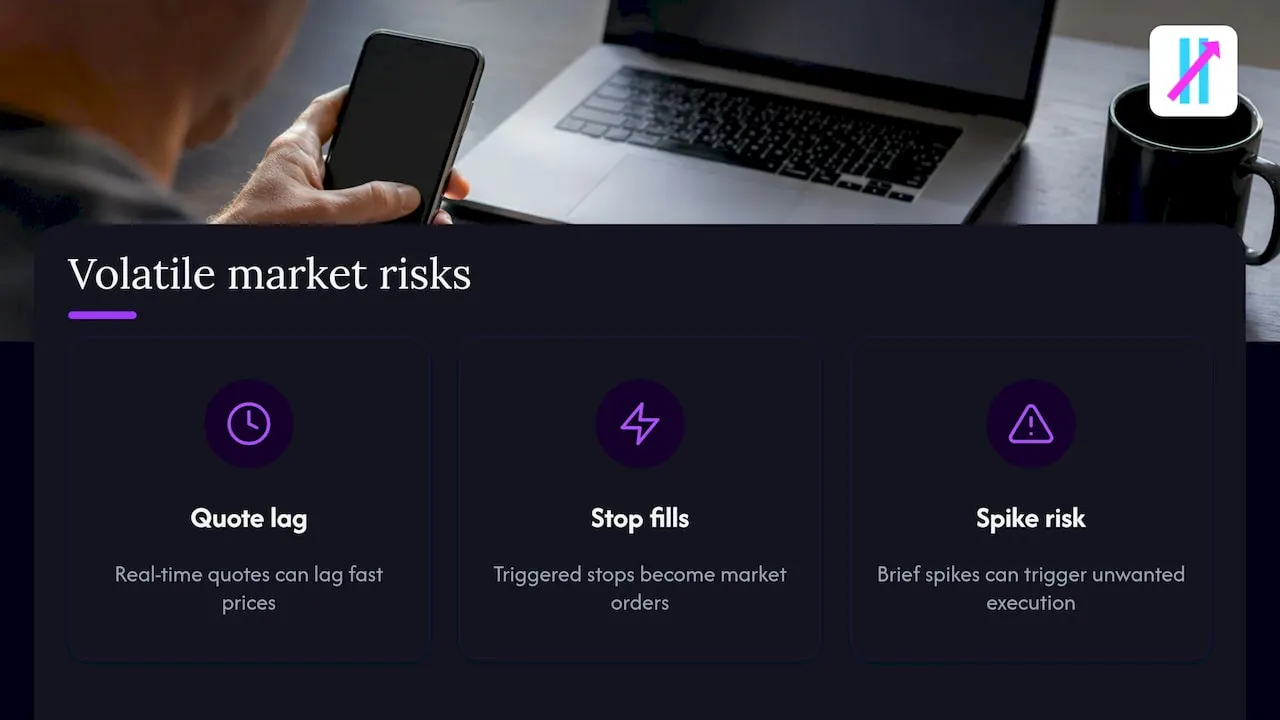
Vanguard explains that volatile markets can bring heavy volume and order imbalances, so prices change quickly and real-time quotes can lag. An order may fill at a materially different price than the quote you saw when you entered it.
Stops are affected too. FINRA Regulatory Notice 16-19 notes that a stop order becomes a market order when triggered, so in volatile markets the fill can differ substantially from your stop price, and a brief spike can trigger an execution you did not want. If your risk math assumes a $1.00 stop, a fast market can turn it into something larger.
Halts and illiquid markets
Trading can be halted because of unusual activity or issuer news. The security futures risk disclosure says that it may be difficult or impossible to liquidate positions during halts, system failures or illiquid conditions. If you cannot reliably get out, you should think hard about getting in.
Well-known events
The CFTC advisory warns against rushing into commodity futures or options because of predictable seasonal demand, public reports or well-known events, since known information may already be priced in. Scheduled releases are a common reason to stand aside until the dust settles.
Choppy, directionless conditions
Trend-following signals struggle when price just chops sideways. This is the situation our Fake Trend Detector is built for: it helps filter out low-quality or misleading conditions where trading may not be recommended. Instead of asking yourself whether this is a real trend, you get a flag that tells you to wait.
Stop for the day: emotional and behavioral signs
Sometimes the market is fine and you are not. Traders and trading-education sites describe a consistent set of warning signs. FinWiz lists an urgent need to make back losses, position size creeping above normal, taking trades that do not meet your criteria, anger at the market, moving stops further away, and the phrase “just one more trade.” Fulltilt adds entering faster than the setup allows.
American Dream Trading points to revenge trading after a loss, chasing running stocks out of fear of missing out, overconfidence after wins, and forcing trades on slow, choppy days. It also notes physical cues such as headaches, neck and shoulder tension and fidgeting.
A simple self-check you can run at any point in the session:
- Am I trading the plan, or trying to fix the last trade?
- Is my size the same as it was this morning?
- Did I move a stop because the chart changed, or because I did not want to be wrong?
- Could I explain this entry to someone in one sentence?
Two “no” answers mean you are done. Close out, step away from the screen and come back tomorrow. For a deeper routine, see our 30-day plan to beat emotional trading with written rules.
Set limits before the session starts
Emotional signs are late warnings. Hard limits are early ones. CME Group’s trade-plan course asks traders to define how much of the account they will risk per trade, how many positions they will hold at once, and their maximum trade loss and maximum day loss.
| Limit | Common guideline | Example on a $50,000 account |
|---|---|---|
| Risk per trade | 1% to 2% of capital (Investopedia) | $500 to $1,000 |
| Daily loss limit | 1% to 2% of capital (American Dream Trading) | $500 to $1,000 |
| Minimum risk-reward | 2:1 or higher | Risk $500, target at least $1,000 |
Position size follows from the stop: divide the dollars you are willing to risk by the distance between entry and stop. Risk $500 with a $1.00 stop and you can buy 500 shares. These are guidelines from education sources, not rules for every account, so pick numbers you can lose without changing how you trade.
Also add a trade count and a time limit. Fulltilt recommends setting boundaries for loss, profit, number of trades and time, and stopping when any one is reached. Stopping after a big win counts too, since overconfidence is on the list above.
Our one-page plan is a practical way to put these numbers on paper, and the guide on following your trading rules when it counts covers how to hold the line when a loss tempts you to break them.
If you use automation, add risk controls
Automated alerts remove hesitation, which also means they can repeat a bad decision quickly. Define your daily stop, trade cap and what happens when the broker fills badly. We cover this in automated trading risk controls, and how fills behave in broker execution speed.
Money you should never put at risk
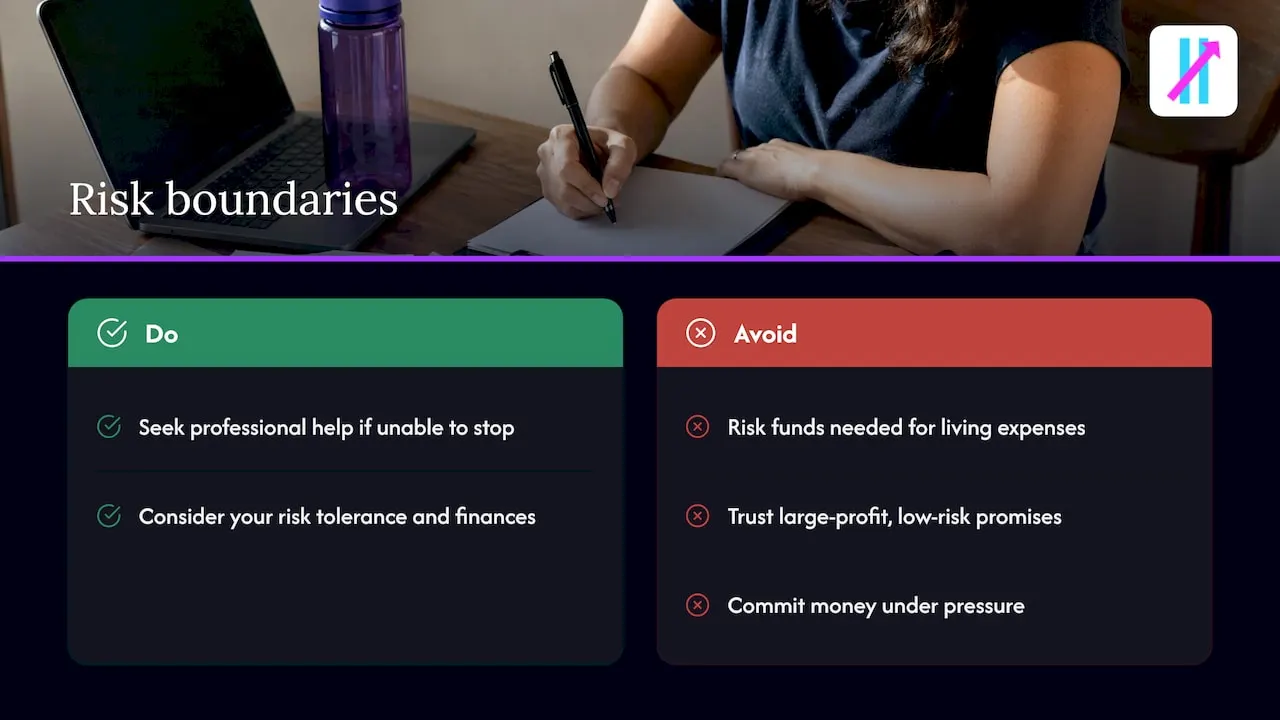
The SEC’s Investor.gov day-trading guide says day trading involves rapid decisions and often leverage, so losses can be substantial and in some cases greater than the amount invested. It also says day trading may be unsuitable if you are uncomfortable with high risk, and that your tolerance depends on objectives, experience, time horizon, finances and aversion to losses.
The security futures disclosure advises against risking funds needed for living expenses, emergencies, retirement, education or housing. The CFTC advisory adds that futures investors can lose more than they put in, and that promises of large profits with little risk, or pressure to commit money immediately, are warning signs to walk away from. If your account holds rent money, you should not be trading it.
If trading is hurting your sleep, relationships or finances, or you feel unable to stop, talk to a licensed mental health professional or your doctor. Loss of control and harm to daily life, not trade frequency alone, are what matter, as AddictionHelp notes.
How Big Move Algo supports the decision to wait
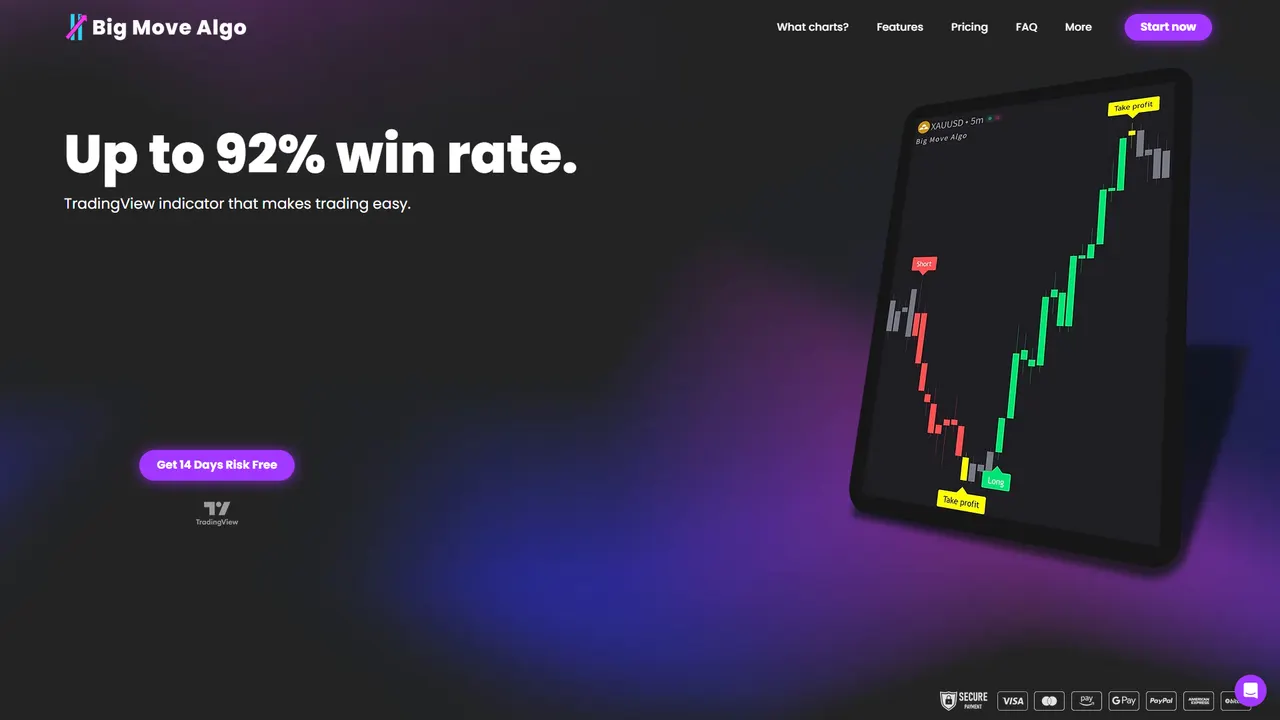
Our indicator gives clear Long, Short and Exit signals on TradingView across crypto, forex, stocks, indices and commodities. AUTO Mode needs minimal setup, and Manual Mode gives experienced traders more customization. The Fake Trend Detector is there so that low-quality conditions are flagged rather than traded. Alerts can go to multiple platforms, and the plans are:
- Version 2: $55 per month or $660 per year
- Version 3: $64 per month or $768 per year
- Version 3 Plus: $79 per month or $948 per year
Access is instant after payment through Stripe, and it works on unlimited devices. You can see the plans on the Big Move Algo site.
A signal tool does not replace your loss limit. It gives you a consistent, structured reference point so that the decision to trade or wait rests on something other than a mood.
Our perspective
Most traders think their problem is finding entries. In our experience building Big Move Algo, the harder problem is the moment after the entry: staying calm, sticking to the exit and declining the trade that is not there.
That is why we designed the product around clarity. Signals are simple. AUTO Mode keeps setup light. The Fake Trend Detector is meant to say “not now” when conditions are poor, because a skipped trade is a protected account.
Pair that with a written daily loss limit and a rule you will not break, and you have a system rather than a series of impulses. Structure is what lets you trade again tomorrow.
Steven Hartwell
FAQ
How do I know when to stop trading for the day?
Stop when you hit your pre-set daily loss limit, trade count or time limit, or when you notice revenge trading, oversized positions or moved stops. Many education sources suggest a daily loss limit of 1% to 2% of capital. Decide the number before the session opens.
Why shouldn’t you day trade?
The SEC’s Investor.gov guide says day trading involves rapid decisions and often leverage, and losses can be substantial, even more than you invested. It may be unsuitable if you are uncomfortable with high risk. Never use money you need for living expenses or emergencies.
Should I trade during volatile news events?
Often it is better to wait. Vanguard notes that in volatile markets quotes can lag and orders can fill at materially different prices. If your plan does not specifically cover news, sitting out until spreads and price action settle is a reasonable rule.
Is it okay to skip a signal?
Yes, if it fails your own checklist, such as risk-reward below your minimum, conditions flagged as low quality, or a missed entry that leaves you chasing. A signal is an input to your plan, and your risk limits still decide whether you act.
Sources
- Investopedia: How To Know When To Pass on a Trade
- Investopedia: Trade Smart, The 5-Step Approval Process
- Caibull Academy: When Not to Trade
- Vanguard: Trading during volatile markets
- FINRA Regulatory Notice 16-19
- Risk Disclosure Statement for Security Futures Contracts
- CFTC Commission Advisory
- FinWiz: When to Stop Trading
- American Dream Trading: How to Know When to Stop Trading for the Day
- CME Group: Risk Management and Your Trade Plan
- Investor.gov: Thinking of Day Trading? Know the Risks
- AddictionHelp: Trading Addiction