How to Avoid Revenge Trading: Rules That Work After a Loss

You avoid revenge trading by deciding, before the session starts, what happens after a loss, and then taking the decision out of your hands in the moment. That means a written if-then rule, a daily loss limit, a fixed cooldown, a size that never changes, and entries that come from a defined signal rather than from the urge to get even. At Big Move Algo, our Long, Short and Exit signals inside TradingView give you that defined trigger, so the next trade has to earn its place instead of being a reaction.
The rest of this guide shows how to spot the pattern early, what to do in the first five minutes after a stop-out, and how to build a setup that makes the impulsive trade harder to place.
TL;DR
- Revenge trading is entering because of the last loss, not because of a setup. It usually shows up as bigger size, faster entries and looser rules.
- The fix is made before the session: a daily loss limit, a cooldown after every loss, and a fixed risk per trade.
- In the first five minutes after a loss, cancel pending orders, log the loss in R, and walk away from the screen.
- Use alerts and a structured signal so your entries come from rules, not from the P&L.
- Journal every trade, and label the revenge trades that happened to win as luck.
Table of Contents
- What revenge trading is, and why it happens
- The warning signs before you click
- Build the rules before the session
- The five-minute reset after a loss
- Take the trigger out of your head
- Push notifications: trade the plan without watching every tick
- Automate the parts you break most
- Review the loss without starting a new one
- A sample daily rule sheet
- Our perspective
- Put a clear signal behind your rules
- FAQ
- Sources
What revenge trading is, and why it happens
Revenge trading is placing a trade to win back money you just lost. Benzinga describes it as impulsive trading driven by fear, anger, greed or shame, which typically leads to bigger positions, ignored stop-losses and abandoned plans. The key word is “because”: the trade exists because of the previous loss, not because your plan produced a setup.
The pull is strong because losses feel worse than equal gains feel good. Charles Schwab’s behavioral-finance guide notes that trading under stress leads to ignoring stops, selling winners too soon and doubling down after a loss. Schwab also points out the opposite reaction: some traders freeze, watch a loss grow because they cannot accept the pain of exiting, or start tweaking a system that was fine.
This is not a beginner-only problem. The SEC’s Investor Bulletin on behavioral patterns of U.S. investors summarizes a Library of Congress report that identifies nine behaviors that can undermine investment performance, including active trading and the disposition effect, which is the tendency to hold losers and sell winners. Experience does not make you immune. Rules do.
The warning signs before you click
You cannot argue yourself out of an oversized trade once you are in the middle of it, so the goal is to catch the pattern earlier. The most common tells are easy to check against your own order history:
- You entered within a few minutes of a losing exit.
- The size is larger than the trade you just lost.
- You cannot write down a reason for the trade that does not mention the loss.
- You are trading the same instrument or direction that just stopped you out, or an instrument you do not normally trade.
- You moved or removed a stop because the trade “has to work.”
- Your trade count is rising while your P&L falls.
- You feel you need to trade rather than want to.
There are body signals too: a tight chest, a racing heart, clenched jaw, heat in the face, a hand hovering over the mouse. And there is a language signal. If you catch yourself saying “the market cheated me,” you have stopped describing what price did and started telling a story about it. Treat sudden, strong certainty right after a loss as a warning, not a green light.
One caution: revenge trading is not always angry. A calm trader can escalate size on schedule and feel fine. That is why the reliable test lives in the record, not the mood. Check time between trades, size versus plan and whether the entry met your criteria.
Build the rules before the session
The rules below work because you write them while calm. The point is not willpower. It is that the decision has already been made.
1. Write the if-then rule
Schwab recommends written if-then plans, such as stepping away for the day after a set loss, or taking 15 minutes when you feel the urge to break a rule. Write yours in plain words, for example: “If I take a loss, I do not enter anything for 15 minutes. If I lose 2R in a day, I am done.” Read it before the open every day. If you want a full structure, our 30 day plan to beat emotional trading with written rules and our one page plan to reduce trading emotions walk through building one.
2. Set a daily loss limit
Pick a number in R or dollars that you can lose without it changing your week, and treat it as a hard stop for the session. Schwab describes this as a “circuit breaker” that blocks additional trading after a set daily loss. Decide the number when you are flat and calm, never after the first red trade.
3. Fix your size
Revenge trades almost always come with a bigger position, because bigger feels like faster recovery. A fixed risk per trade removes that lever. A common approach is risking a small fixed percentage of the account and sizing from the stop distance. Our guide to position sizing with 1% fixed fractional and ATR shows the math, and the ATR stop loss guide shows how to set the stop that the size depends on.
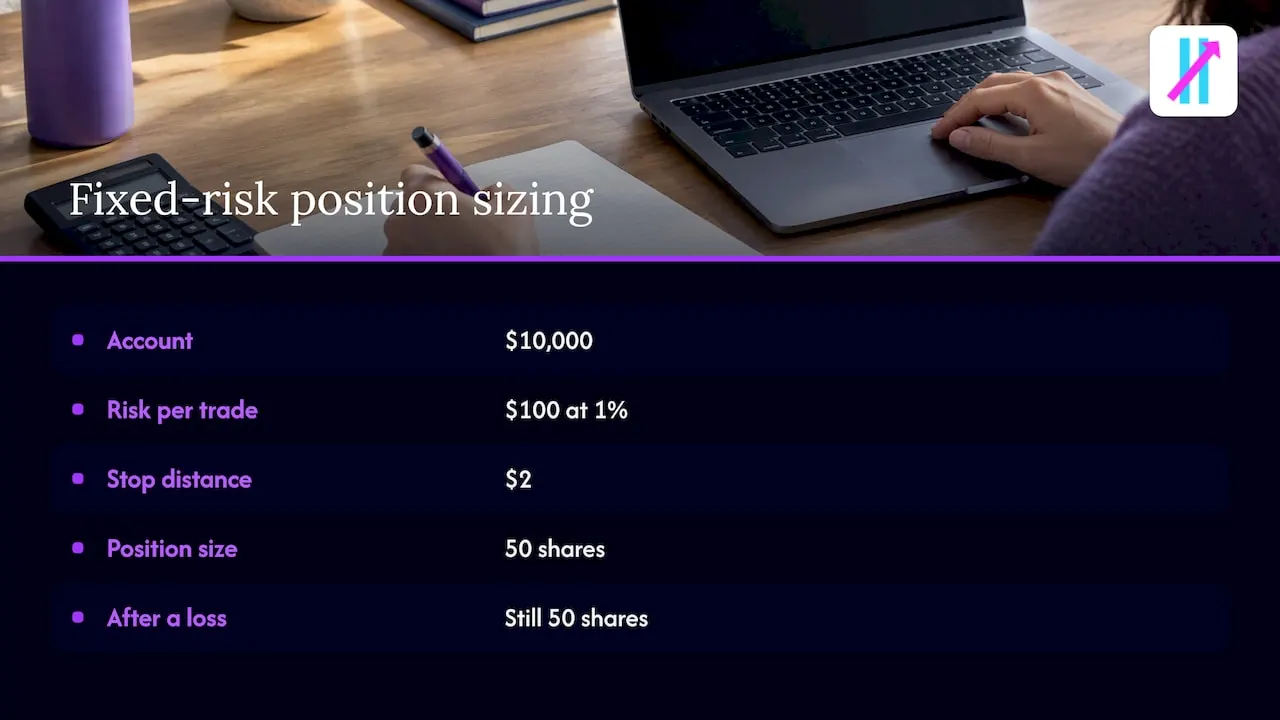
A worked example: with a $10,000 account and 1% risk, you risk $100 per trade. If your stop is $2 away from entry, the size is 50 shares. After a loss the size stays at 50 shares, and the stop distance, not your mood, decides it. If you want to formalize the wider discipline, a risk management course covers loss thresholds and predefined risk rules in more depth.
4. Use a cooldown that is not optional
Time is the cheapest fix. Kathy Lien’s article on Investing.com reports that performance is weakest in the first minutes after a loss, that about 15 minutes is a reasonable average recovery period (with a range of 5 to 45 minutes), and that most tilt-driven trades happen within the first five minutes. A mandatory 15-minute break covers the worst window. If you tend to get pulled back sooner, lengthen it.
The five-minute reset after a loss
The same Investing.com piece lays out a “Five-Minute Firewall.” Here is the routine in a form you can print and tape to your monitor:
- First 30 seconds: cancel any unplanned pending orders and close the order entry window.
- Minute one: record the loss in R (for example, -1R), not in dollars. Dollars invite emotion. R keeps it a measurement.
- Minutes two and three: ask three questions. Would I take this trade if the last one had won? Does it meet my normal criteria? Am I trading the market or trying to recover the loss?
- Minutes four and five: leave the screen and set a 15-minute timer.
If the answer to the third question is “recovering the loss,” the session ends or the cooldown extends. No exceptions, no “one more.”
Take the trigger out of your head
Most revenge trades are discretionary: a gut feeling dressed up as a setup. The cleaner your entry definition, the less room for that. This is where tooling helps. Big Move Algo is a TradingView indicator that analyzes markets in real time and gives clear Long, Short and Exit signals, across crypto, forex, stocks, indices and commodities. When your entry is a defined signal, “I want my money back” is not a valid reason to trade, and you can see it is not.
Two features matter specifically for the post-loss moment:
- Fake Trend Detector. It is built to filter out low-quality or misleading market conditions where trading may not be recommended. Chop after a stop-out is exactly where forced trades happen.
- AUTO Mode. It needs minimal setup, so your rules are not rewritten on the fly. Experienced traders who want more control can use Manual Mode, but the discipline is the same: settings are chosen before the session, not after a loss.
Our indicator does not repaint, so the signal you saw is the signal that is on the chart. That matters when you review a loss honestly: you are judging a decision, not a chart that changed afterward.
Push notifications: trade the plan without watching every tick
Staring at the chart all day is a revenge-trading machine. Every wobble becomes a temptation. A better pattern is to let alerts do the watching and come to the screen only when your plan says something happened.
On mobile, TradingView’s own instructions are short. According to its support page on phone notifications for alerts, you install the TradingView app, log in, allow the app to send push notifications in your phone settings, and check the “Notify in App” box when you create the alert.
A few habits make alerts support discipline rather than feed impulse:
- Alert on your plan, not on price noise. Set alerts for your signal conditions and for levels you decided on in advance.
- Treat an alert as a prompt to check your checklist, not as an order to act. The question after the ping is still “does this meet my criteria?”
- Mute after the loss limit. When your daily limit is hit, turn off the alerts for the day so the phone cannot pull you back.
Big Move Algo delivers alerts to multiple platforms and supports unlimited devices, so the same signal reaches you wherever you are. If you want to decide between alerts and full automation, our guide on alerts or automation for TradingView sets out a 2 to 4 week test. And if you want exits handled for you, see our pieces on take profit alerts and trailing stop alerts.
Automate the parts you break most
Schwab recommends automating entries and exits, and especially exits, with automatic stops and circuit breakers. The reasoning is simple: a stop that exists as an order cannot be argued with at 10:42 a.m. after a bad morning. Big Move Algo allows integration with automated trading platforms, which lets you connect signals to execution with the rules you chose in advance. Our automated trading risk controls guide lists the controls worth having in place before you automate anything.
Review the loss without starting a new one
The review is where many traders slip back in. You open the chart to “see what went wrong” and end up placing a trade. Keep the review out of the trading window:
- Review after the session, not during the cooldown.
- Journal every entry made within minutes of a losing exit, and flag it.
- Label revenge trades that won as lucky. A win does not make the decision right, and it makes the habit harder to drop.
- Once a week, count how many trades broke the cooldown and what they cost in total.
New to journaling? Start with what a trading journal is and why it matters. Write the trigger, the thought, the emotion and the action. Putting it on paper takes some of the heat out of it.
One more point on size and recovery: adding to a position after a loss feels like “averaging in,” but it is often the same impulse. If you do scale into trades as part of your plan, our guide on scaling in without adding risk shows how to do it with rules.
A sample daily rule sheet
| Situation | Rule |
|---|---|
| After any loss | Cancel pending orders, log in R, 15-minute timer |
| Next entry | Must match the signal and written criteria |
| Size | Unchanged, set from stop distance |
| Two losses in a row | Extra break, review the checklist |
| Daily loss limit hit | Session over, alerts muted |
| After the close | Journal, flag any trade inside the cooldown |
Adjust the numbers to your account and style. A day trader may use a shorter cooldown and a swing trader may use a full day. What matters is that the sheet exists before the loss.
Our perspective
Most of the traders we build for are not short of information. They are short of structure. After a loss, a trader with a blank screen and a P&L in red will find a reason to trade, so we think the answer is to make the reason come from somewhere else.
That is the idea behind Big Move Algo. A clear Long, Short or Exit signal gives you an entry definition you can write down and check. The Fake Trend Detector is designed to flag conditions where trading may not be recommended, and AUTO Mode keeps setup light so your energy goes into following the plan, not rebuilding it.
Pair that with a fixed risk per trade, a daily limit and a cooldown, and the urge to get even loses most of its room to operate. Discipline is easier when the system is clear.
Steven Hartwell
Put a clear signal behind your rules
If your entries come from a defined signal, a revenge trade is easy to recognize because it has none. Big Move Algo gives TradingView users Long, Short and Exit signals with instant access after purchase and free updates. Plans are $55 per month or $660 per year for Version 2, $64 per month or $768 per year for Version 3, and $79 per month or $948 per year for Version 3 Plus. You can see the plans and pick one on bigmovealgo.com.
Trading involves risk, and no indicator or rule set guarantees profits or removes losses. The aim here is to keep a normal loss from becoming a bigger one.
FAQ
How do I stop revenge trading right after a loss?
Cancel pending orders, record the loss in R, and leave the screen with a 15-minute timer. Do not take another trade until it meets your written criteria. If your daily loss limit is hit, end the session.
How long should I wait after a loss before trading again?
Fifteen minutes is a common starting point, and the Investing.com piece cited above puts the typical recovery range at 5 to 45 minutes. If you notice yourself rushing back, make it longer, or stop for the day after a set loss.
Can alerts help me avoid revenge trading?
Yes, when they are built around your plan. TradingView push notifications let you step away from the chart and respond only when a signal or level you chose in advance triggers. Mute them once you reach your daily limit.
What is the difference between revenge trading and overtrading?
Revenge trading is driven by a specific loss and the wish to recover it. Overtrading is taking more trades than your plan calls for, for any reason. They often show up together, and the same rules, a trade cap, a loss limit and a cooldown, address both.
Sources
- What is Revenge Trading? (Benzinga)
- How to recover from a major trading loss (Charles Schwab)
- Investor Bulletin: Behavioral Patterns of U.S. Investors (Investor.gov)
- The Most Dangerous 5 Minutes in Trading (Investing.com)
- How to receive phone notifications for alerts (TradingView Support)